
As the global population lives longer, maintaining cognitive vitality has become a top priority in modern medicine. While physical aging is inevitable, the rapid decline of memory, focus, and mental clarity does not have to be. For decades, neuroscientists searched for pharmaceutical interventions to halt cognitive decline. Today, however, some of the most exciting breakthroughs are happening in the nutritional sciences.
At the center of this research is a humble superfood: the blueberry. Specifically, researchers are focusing on a family of potent antioxidants called anthocyanins. In this deep dive, we will explore the precise mechanics of how anthocyanins protect aging brains, optimize neural communication, and clear away the cellular debris that accelerates brain aging.
The Aging Brain and the Threat of Neuroinflammation
To understand how these fruit compounds work, we must first look at what happens to our gray matter over time. The human brain consumes roughly 20% of the body’s total oxygen energy, despite making up only 2% of its weight. This intense metabolic activity makes the brain highly susceptible to oxidative stress.
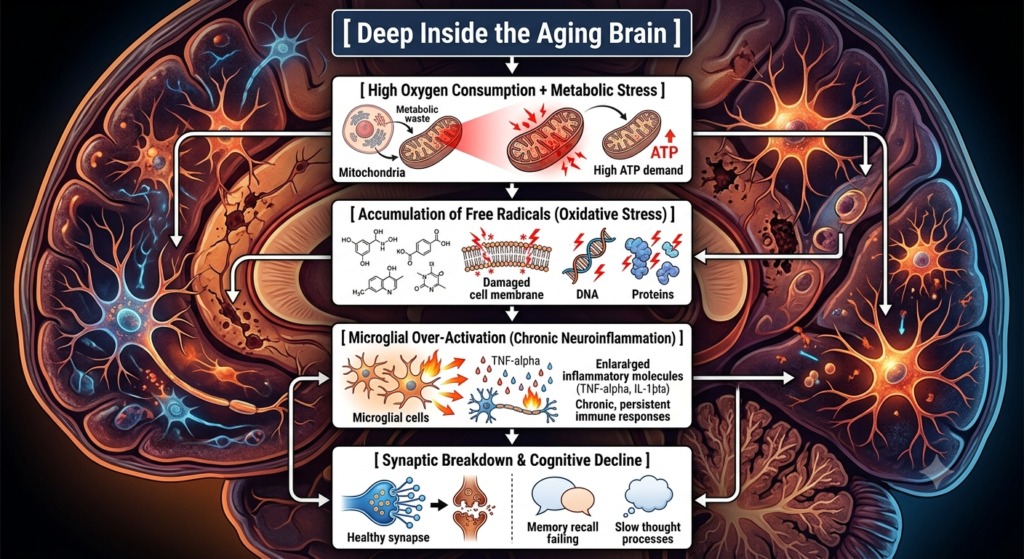
When free radicals outnumber the brain’s internal defenses, they damage neurons, disrupt synapses, and trigger chronic neuroinflammation. This slow-burning inflammatory fire is driven by microglia—the immune cells of the brain. In a young brain, microglia clean up cellular waste. In an aging brain, they can become chronically hyperactive, releasing harmful proteins like TNF-alpha and IL-6 that destroy healthy brain tissue. This destructive process is a primary driver of age-related memory issues and cognitive decline.
What Are Anthocyanins?
Plants produce secondary metabolites to protect themselves from environmental stressors like ultraviolet radiation and cold weather. Anthocyanins are water-soluble pigments belonging to the flavonoid family. They give blueberries, blackberries, and purple grapes their deep, vibrant colors.
While many fruits contain antioxidants, wild blueberries are uniquely concentrated powerhouses. They contain a complex profile of specific anthocyanins, including:
- Cyanidin
- Delphinidin
- Malvidin
- Peonidun
The critical reason these compounds are so effective at protecting our mental clarity is their unique molecular structure. Unlike many dietary antioxidants that cannot cross from the bloodstream into the central nervous system, anthocyanins successfully cross the tight cellular gateway known as the blood-brain barrier (BBB). Once inside, they directly enter areas of the brain responsible for learning and memory, such as the hippocampus.
The Science of How Anthocyanins Protect Aging Brains
The true power of these wild blueberry pigments goes far beyond simply cleaning up free radicals. Instead, they act as cellular signaling molecules that tell the brain to protect itself. Clinical studies reveal four distinct ways how anthocyanins protect aging brains at the cellular level.
1. Turning Down the NF-$\kappa$B Inflammatory Master Switch
When brain cells encounter metabolic stress, they activate a genetic master switch called NF-$\kappa$B. Once turned on, this switch instructs the cell nucleus to mass-produce inflammatory cytokines. Neuroscientists have discovered that anthocyanins actively block the activation of this pathway. By keeping this switch in the “off” position, blueberries help quiet microglial hyperactivity, keeping chronic neuroinflammation at bay.
2. Boosting the Nrf2 Cellular Defense System
While anthocyanins suppress harmful inflammatory pathways, they actively turn up protective ones. They stimulate the Nrf2 pathway, which controls your body’s internal antioxidant manufacturing plant. Activating Nrf2 prompts your brain cells to produce critical enzymes:
- Superoxide Dismutase (SOD): Neutralizes highly destructive oxygen radicals.
- Glutathione: The body’s master antioxidant that protects delicate mitochondria.
3. Enhancing Brain-Derived Neurotrophic Factor (BDNF)
Your brain possesses a remarkable ability to rewire itself and grow new connections, a process known as neuroplasticity. This process is driven by a vital growth protein called Brain-Derived Neurotrophic Factor (BDNF). Think of BDNF as fertilizer for your neurons.
As we age, BDNF levels naturally drop, making it harder to retain new information. Regular consumption of blueberry anthocyanins has been shown to upgrade BDNF expression in the hippocampus, helping aging brains maintain structural plasticity and form new memories easily.
4. Improving Microvascular Blood Flow
Your brain cells require a steady supply of oxygen and glucose to fire efficiently. Chronic inflammation often damages the small capillaries supplying the brain, reducing blood flow. Anthocyanins promote the production of endothelial nitric oxide, a compound that relaxes and widens blood vessels. This improved microvascular blood flow ensures that aging neurons receive the nourishment they need to clear metabolic waste products.
What Human Clinical Trials Reveal
The cellular mechanics are impressive, but do these changes transfer into real-world cognitive improvements for humans? A growing body of randomized, double-blind, placebo-controlled human trials says yes.
| Clinical Study Target | Duration | Main Intervention | Observed Cognitive Outcome |
| Older Adults with Mild Cognitive Decline | 12 Weeks | Wild Blueberry Juice Daily | Significant improvements in paired-associate learning and word recall. |
| Healthy Older Adults (Ages 65–80) | 6 Weeks | Standardized Blueberry Extract | Enhanced activation of brain regions associated with executive function during tasks. |
| Middle-Aged Adults with Metabolic Risk | 12 Weeks | Whole Freeze-Dried Blueberry Powder | Improved executive control and reduced postprandial insulin spikes. |
In one landmark study, older adults experiencing early memory decline drank wild blueberry juice daily for twelve weeks. At the end of the trial, the blueberry group showed significant improvements in word list recall and spatial memory compared to the placebo group. Functional MRI scans confirmed increased blood flow and neural activation in the cognitive centers of their brains.
Practical Guide: Maximizing Anthocyanins in Your Diet
If you want to use the neuroscience of berries to support your long-term cognitive health, consistency and sourcing matter. Here is how to optimize your daily intake:
- Choose Wild Blueberries When Possible: Wild blueberries are smaller than cultivated varieties, meaning they have a higher skin-to-pulp ratio. Because anthocyanins live primarily in the skin, wild berries can contain up to two to three times the antioxidant capacity of larger, conventional blueberries.
- Incorporate Freeze-Dried Powders: If fresh or frozen wild blueberries are unavailable, high-quality, organic freeze-dried wild blueberry powder is an excellent alternative. One tablespoon of powder often delivers the anthocyanin equivalent of a half-cup of fresh berries.
- Avoid Excess Refined Sugars: To maximize your brain health benefits, enjoy your berries whole, blended into low-sugar smoothies, or stirred into raw oatmeal. Avoid commercial blueberry pies or heavily sweetened preserves, as high sugar spikes can trigger the exact inflammatory pathways you are trying to turn off.
To dive deeper into how nutrition impacts full-body health, explore our previous analysis on how citrus fruit polyphenols help reduce chronic inflammation, which details how different fruit families shield the cardiovascular system from metabolic stress.
Conclusion: A Simple Habit for Long-Term Cognitive Health
Protecting your brain from the effects of aging does not require over-complicated routines. The evolving neuroscience surrounding wild blueberries proves that eating nutrient-dense fruits can deeply alter our cellular health.
By understanding how anthocyanins protect aging brains—by shutting down neuroinflammation, boosting BDNF, and shielding delicate neural pathways from oxidative stress—we can actively take control of our cognitive longevity. Adding a single cup of wild blueberries to your daily routine is a simple, evidence-based habit that feeds your brain cells the tools they need to stay sharp, resilient, and vibrant for years to come.